Friday, October 21, 2011

Luis Lionel Andrés Messi


Birth day: June 24, 1987
Birthplace: Rosario, Argentina
Nationality: Argentinian
Other nationality: Spanish
EU passport: Yes
Height: 169 cm
Weight: 67 kg
Club: FC Barcelona
Position: Forward
Debut: 17 November 2003


Lionel Andrés Messi (born June 24, 1987 in Rosario) is an Argentine football (soccer) player.

Lionel Messi started playing football at a very early age in his hometown's Newell's Old Boys. From the age of 11, he suffered from a hormone deficiency and as Lionel's parents were unable to pay for the treatment in Argentina, they decided to move to Barcelona, Spain.

In the 2003-2004 season, when he was still only 16, Messi made his first team debut in a friendly with Porto that marked the opening of the new Dragao stadium. The following championship-winning season, Messi made his first appearance in an official match on October 16, 2004, in Barcelona's derby win against Espanyol at the Olympic Stadium (0-1).

With several first team players seriously injured, the services of several reserve team players were called upon, and Messi became a regular feature of Barça squads. On May 1, 2005, he became the youngest player ever to score a league goal for FC Barcelona - against Albacete when Messi was only 17 years, 10 months and 7 days old.

He was offered the chance to play for the Spain national football team, but declined, prefering to wait for the opportunity to play for the country of his birth. In June 2004 he got his chance, playing in a U-20 friendly match against Paraguay.
Lionel Messi wearing FC Barcelona's colorsIn June 2005 he starred for the Argentina U-20 team that won the Football World Youth Championship played in The Netherlands.Messi picked up the Golden Boot as top scorer with 6 goals, and the Golden Ball for the best player of the tournament. Despite his youth, Lionel has already drawn comparisons with Diego Maradona, arguably the best football player of all time.

On September 25, 2005 Messi obtained a Spanish citizenship and was finally able to make his debut in this season's Spanish First Division. He had previously been unable to play because FC Barcelona had filled up all of their quota of non-EU players.

Messi's first outing in the UEFA Champions League at the Nou Camp was on Sept 28 against Italian club Udinese. He impressed with some great passing and a seemingly telepathic relationship with Ronaldinho that earned him a standing ovation from the 70,000-odd Nou Camp faithful. On December of that year, the Italian newspaper Tuttosport awarded him the Golden Boy 2005 title for the best under-21 player in Europe, over Wayne Rooney and Lukas Podolski

Omar Abdullah


HE is a Indian Kashmiri politician and the scion of Kashmir's 'first family', the Abdullah family who became the 11th and the youngest Chief Minister of Jammu and Kashmir after forming a government in coalition with the Congress party, on January 5, 2009.

Prior to this he was a member of 14th Lok Sabha, representing Srinagar constituency of Jammu and Kashmir, India. He was a Union Minister of State for External affairs in Atal Bihari Vajpayee's NDA government, from July 23, 2001 to December 23, 2002, when he resigned from the post in protest against the violence in Gujarat in 2002.

He is the grandson of Sher-e-Kashmir, Sheikh Abdullah, who formed Kashmir�s first political party the Muslim Conference in 1932, which was later rechristen as National Conference. He remained the Prime Minister of Jammu and Kashmir 1948-1953, and also Chief Minister of Jammu and Kashmir two times, 1975 and 1977. After his death in 1982, his son Farooq Abdullah dominated the political arena for many years and remained the Chief Ministers of Jammu and Kashmir thrice in 1982, 1986 and 1996. Farooq�s son Omar joined politics in 1998, as a Lok Sabha member, a feat he repeated in subsequent three elections and also remained a Union minister; he took on the mantle of National Conference from his father in 2002, though he lost his own seat of Ganderbal during the 2002 state assembly elections, and so did his party, the political mandate; four year later, he fought once again from the very seat and won in the 2008 Kashmir Elections.


Omar Abdullah born 10 March 1970, is the son of Farooq Abdullah and grandson of Sheikh Abdullah, both have remained Chief Ministers of Jammu and Kashmir.His mother Mollie, a British Christian, and a Nurse by profession, was not in favor of him joining politics. Early on he studied at the Burn Hall School Srinagar. He later studied at the exclusive institution The Lawrence School, Sanawar. He is an alumnus of prestigious Sydenham College, Mumbai.After that he joined University of Strathclyde, Scotland, where he did his B.Com. and MBA.

He married Payal Singh, daughter of an Army officer, Kran Ram Singh from Delhi on September 1, 1994, and the couple had two sons, Zahir and Zamir hence . His sister Sarah Abdullah is married to Rajesh Pilot's son Sachin Pilot.

In 1998, he was elected to 12th Lok Sabha. In 1998-99, he was Member, Committee on Transport and Tourism and Member, Consultative Committee, Ministry of Tourism. He was the youngest Minister at the age of 29. In 1999, he was re-elected to 13th Lok Sabha (2nd term).[14] On October 13, 1999 he took oath as Union Minister of State, Commerce and Industry. On July 22, 2001, he became the youngest Union Minister, when he was made Union Minister of State for External affairs, a post he resigned from on December 23, 2002, as protest to the 2002 Gujarat violence.

On June 23, 2002, he became the President of National Conference replacing his father Farooq Abdullah.he was re-elected as party's President for a second term in 2006.

In March 2006, much to the disapproval of the centre, Omar Abdullah had a one-on-one meeting with Pakistan President, Pervez Musharaf in Islamabad. This was the first meeting of its kind between a main-stream politician from Jammu & Kashmir and the Pakistani government thereby re-enforcing Omar's growing commitment to the solution of the Jammu & Kashmir cause - no matter what the stakes might be; Omar received a rousing reception by thousands of Kashmiris upon his return from there.

On July 9, 2007, Omar escaped a bid on his life when suspected militants threw two rifle grenades targeted at him. The incident happened when Omar was interacting with party workers at a party leader's house.

On July 22, 2008, Omar gave a passionate speech during the 2008 Lok Sabha vote of confidence , which was praised by almost all quarters, and even won him fans on the net. He was also seen briefly, playing himself in director, Apoorva Lakhia�s film, Mission Istanbul (2008), based on international terrorism.

After the 2008 Kashmir Elections, the National Conference won the maximum number of seats, and formed a coalition government with Congress party, and Omar was sworn in as the 11th Chief Minister of Jammu and Kashmir on January 5, 2009 at the General Zoravar Singh Stadium in the University of Jammu, Jammu, raising hope amongst the people of Jammu and Kashmir who have been reeling under insurgency and violence since 1989 .As during the Election Campaign ,National Conference has accepted that Kashmir is yet to be resolved and Election is for governance whileas Separatists APHC (All Parties Hurriyat Conference) are for resolution of Kashmir Issue.Omar has promised to facilitate the talks between government of India and Pro-Freedom APHC leaders.

Humpy Koneru

Humpy Koneru (Telugu : కోనేరు హంపీ) (born 31 March 1987 in Gudivada, Andhra Pradesh) is a chess grandmaster from India. Her October 2007 FIDE Elo rating was 2606, placing her at number two in the world for women (behind Judit Polgar), breaking the record of 2577 set by Susan Polgar for the second-highest ranked female player in Chess history and becoming the second female player ever, after Judit Polgar, to cross the 2600 elo mark.[1] [2] Humpy was originally named Hampi (after the ancient city) by her parents but her father later changed it to Humpy, a more Russian-sounding name. She writes her family name (Koneru) before her given name[citation needed], as is the convention with Telugu speaking people. Humpy held the record from 2002 to 2008 for the youngest woman ever to become a grandmaster (not merely a Woman Grandmaster), which she achieved in 15 years, 1 month, 27 days, beating Judit Polgar's previous record by 3 months.[3] However she later lost this record to Hou Yifan. In 2001 she won the World Junior Girls Chess Championship. In 2006 she participated in the Women's World Chess Championship, but was eliminated in the second round.[4] In the Women's World Chess Championship 2008 she made it to the semi-finals, but was beaten by Hou Yifan.

Amrapali Ambegaokar

Amrapali Ambegaokar left her position as Principal Dancer in Cirque Du Soleil in over 730 shows over 2 years so that she could pursue her secret childhood dream of acting with the purpose of expanding her artistic career from the stage to the challenge of Film and TV. With recurring roles on Grey's Anatomy in 18 episodes and Guest starring roles on Heroes and credits on Desperate Housewives, Alias, Boston Legal, ER and films Gone Hollywood, Naach by Ram Gopal Varma, Extra Ordinary Barry and American Blend (as an actor, choreographer, dancer, vocalist), Amrapali has definitely expanded herself as an artist as she continues to achieve her dreams.

Amrapali Ambegaokar is known as a young International Master of Kathak (North Indian Classical) Dance and is "by far one of the best Kathak Dancers around." (Victoria Looseleaf - Los Angeles Times) and "a joyous monument to multiculturalism." (Lewis Segal - Los Angeles Times). "The strongest technical skills and performance personalities ...with the always remarkable Kathak performer, Amrapali Ambegaokar" and "Amrapali's acting is subtle and nuanced"- Los Angeles Times. Amrapali performed as a guest on season 5 of Fox's So You Think You Can Dance and also won the coveted Solo Silver Medal in the International hit show NBC's Superstars of Dance produced by Mastermind Producer and Director Nigel Lithgoe (American Idol, and So You Think You Can Dance) with a solo appearance on NBC's Today Show.

Having won numerous awards and accolades since childhood, Amrapali was famously the Principal Dancer of Cirque Du Soleil's Dralion in over 730 shows in 14 US cities. With performances on The Tonight Show with Jay Leno and several major television appearances, Amrapali has been the Principal dancer of Anjani Dance Theater with highlights including The Hollywood Bowl, Ravinia Festival Chicago, World Music Institute NY, United Nations D.C., National Geographic Society and hundreds more since age 13 and is the disciple of Master and NEA Lifetime Achievement awardee Anjani Ambegaokar since age 3.

With a BA Honors from UCLA's World Arts and Cultures/Dance department, Amrapali's special honors also include The Music Center SpotlightAward, Celebrity Queen Azalea of the 62nd Azalea Festival as well as the U.S. National judge for Sony TV's Boogie Woogie Dance competition, Celebrity judge for the Miss Asian America Pageant and more. Amrapali is a pageant title holder as Miss Asian America Talent, Miss Asian California, Miss India North America Princess, Miss India North America Talent, and Miss India USA Talent. Since her early teens, Amrapali has graced the covers of The Los Angeles Times, Dance Magazine, Show Magazine, Parade Magazine, 002 Magazine, Celebrity Magazine, India Currents Magazine and so many others.

Amrapali was also invited to perform as a soloist for Dance Moves II held by the Academy of Television Arts and Sciences (The Emmys) Annual concert celebrating dance and choreography in film and TV. Amrapali also performed as a duet with Grammy award winning composer and Master Trumpeter Mark Isham in a Kathak/Jazz collaborative duet for the Celebrity Centre International's 40th Anniversary Gala ending off in a finale' with Legendaries Chakka Khan, Chick Corea, and Stanley Clarke.

Amrapali's choreography credits include live stage, pageants, film and television, music videos and commercials. Amrapali is recognized for her traditional work as well breaking boundaries by infusing Kathak with Flamenco, Hip Hop, Bollywood, Folk and modern styles. Amrapali feels blessed to be one of the leading artists today of Indo-American heritage flourishing in numerous artistic mediums Internationally and continues to serve as a true torchbearer of the arts.

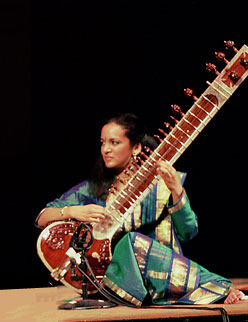
Anoushka Shankar


Anoushka Shankar is a rising young star of the Indian sitar. She is a student, and daughter of the legendary Ravi Shankar.

She was born in London in 1982, and spent her early years shuttling back and forth between London and New Delhi. She gave her debut performance in New Delhi at the tender age of 13. Later, she moved to Encinitas, CA, where she graduated from High School with honours in 1999.

Although she is still very young, Anouskha has an impressive performing and recording career. She regularly accompanies her father in performances; this she has been doing for quite a few years. In 1998, she released her first solo album, "Anourag". Two years later, she released the Grammy nominated "Live at Carnegie Hall". Her stage career is very extensive, for she has performed in most of the world's major venues.

Anoushka Shankar's career is not limited to music. In 2002 she published a book entitled "Bapi, The Love of My Live"; this is a pictorial biography which pays special tribute to her father, Ravi Shankar. She has also acted in films; in 2003 she acted in the film "Dance Like a Man", where she plays a young Bharat Natyam dancer.

Anoushka Shankar's career continues to unfold, and we can expect to see many things from her in years to come.

Kumar Ram Narain Karthikeyan


Kumar Ram Narain Karthikeyan was born on January 14th, 1977 into an illustrious family renowned as much for its endeavours in education, enterprising businesses and philanthropic passion as it is on the racing circuit. Narain was quick to inherit the racing genes from his father Shri.G.R.Karthikeyan who was a former Indian National rally champion, winning the South India rally seven times.
Recognising his son’s love for the sport, Narain’s father had him enrolled into the prestigious Elf-Winfield School in France to undergo professional training. Since then, there has been no looking back for Narain.
Placing India on the world map of motorsport and called ‘The Fastest Indian in the World’ by Autosport (the world’s premier automotive racing magazine), Narain Karthikeyan continues to bring laurels to the country...
Prime Minister Dr. Manmohan Singh has congratulated Narain Karthikeyan for winning the Feature Race in A1GP. Applauding Karthikeyan's victory, Dr. Singh said "He is a true representative of India's young spirit and he has set an example for the entire motorsports fraternity of India to follow."

Chetan Bhagat

Chetan Bhagat is an Indian author who has written Five Point Someone - What not to do at IIT , One Night @ the Call Center, The Three Mistakes of My Life and 2 States - The Story Of My Marriage. He has also written the script of Hello, the Hindi movie based on One Night @ the Call Center.

Chetan Bhagat was born in New Delhi and studied in the Army Public School, Dhaula Kuan, New Delhi. He studied Mechanical Engineering at The Indian Institute Of Technology (IIT) and then studied at Indian Institute of Management Ahmedabad (IIM) where he was named "The Best Outgoing Student". He worked as an Investment Banker with Deutsche bank for eleven years in Hong Kong and moved to Mumbai with his wife Anusha in 2008. Later he gave up his job to devote his entire time to his writings. He is married to Anusha, who was his classmate in IIM.

Bhagat's writing style tends to be simple, with linear narratives and vivid storytelling. His protagonists tend to be named after Lord Krishna, like Hari, Shyam, Govind or Krishna.All his books have a number in the title (eg. 'five' in the first, 'one' in the second, 'three' in the third and 'two' in his latest book.) When asked about this Chetan replied 'I'm a banker, I can't get numbers out of my head."

In response to poor reviews from critics, Bhagat described the books as entertainment, rather than attempts at serious literature.

He is a columnist with Dainik Bhaskar & The Times Of India, and writes on political issues. He is an NRI and a citizen of Singapore.

Bhagat has an op-ed column in Dainik Bhaskar, a large Hindi newspaper and another at The Hindustan Times, an English daily.He says "The main purpose of the books and films is to entertain, but the columns allow me to give my views on how the nation should be run."

Some of his columns have been discussed in the Indian Parliament. His articles are written in simple English to achieve mass appeal. He also visits Educational Institutions in India to give motivational talks. His speech 'Spark' in Pune attained widespread fame and was published in many newspapers

Irom Chanu Sharmila


Irom Sharmila Chanu (born March 14, 1972), also known as the "Iron Lady of Manipur" or "Menghaobi" ("the fair one") is a civil rights activist, political activist, and poet from the Indian state of Manipur. Since 2 November 2000, she has been on hunger strike to demand that the Indian government repeal the Armed Forces (Special Powers) Act, 1958 (AFSPA), which she blames for violence in Manipur and other parts of India's northeast. Having refused food and water for more than ten years, she has been called "the world's longest hunger striker"

Novak Djokovic

novak-djokovic-champion
  • Began playing at age four and made his pro debut at 16
  • Nicknamed Nole
  • Father, Srdjan and mother, Dijana own a pizzeria and pancake restaurant on a mountain in Serbia for last 15 years
  • Father, uncle and aunt were all professional skiers and his father was also an excellent soccer player
  • His father wanted him to be a soccer player or skier but excelled in tennis at an early age
  • Credits his family as inspiration for giving him so much support and says he wouldn’t be able to be where he is without their help
  • Younger brothers Marko (born Aug. 20, 1991) and Djordje (born July 17, 1995) are both in school and play tennis
  • Idol growing up was Pete Sampras
  • At age 12, attended Niki Pilic Academy in Munich and practiced there for almost two years before returning to Belgrade
  • Speaks Serbian, Italian, German and English
  • Favorite surface is hard courts but considers himself an all around player
  • Best shot is backhand down the line
  • As a junior, advanced to Australian Open junior singles and doubles SF (w/Jenkins) in 2004
  • Has a 12-4 career singles record (2-0 in doubles) in 10 Davis Cup ties since 2004
  • His family invited 50 underprivileged Kosovo-Serb children to Belgrade in September 2007 to be courtside for Serbia-Australia Davis Cup World Group tie
  • Appeared in September 2007 Vogue Magazine
  • Named 2006-07 ATP Most Improved Player of Year
  • Elected to two-year term in June 2008 to ATP Player Council
  • Works with physiotherapist Milan Amanovic and physical trainer Ronan Bega
  • Coached by former ATP pro and Slovak Republic native Marian Vajda (since June 2006).

Naveen Jindal


Naveen Jindal is a dynamic, handsome political leader and businessman. He become Lok Sabha Member second time. He is an industrialist with operations located in Madhya Pradesh and Chhattisgarh. He also own a private school [NC Jindal Public School] in New Delhi, India located in West Delhi in Punjabi Bagh area.

Naveen Jindal profile and Biography

Date of Birth of Naveen Jindal he was born on March 09, 1970

Birth Place of Naveen Jindal he was born in Hisar (Haryana).

Marital status of Naveen Jindal he got married on 28 May 1994 with
Smt. Shallu Jindal.

Education of Naveen Jindal He has done B.Com. (Hons.)from Hansraj College, University of Delhi and MBA from University of Texas, Dallas, U.S.A.

Family of Naveen Jindal


Naveen Jindal is the son of former Minister of Haryana Late Shri Om Prakash Jindal and mother of Naveen Jindal Smt. Savitri Jindal is the non-executive chairperson of Jindal Steel and Power Limited and JSW Steel, and member of the Haryana Vidhan Sabha, MLA. Wife of Naveen Jindal is Smt. Shallu Jindal and he has two children's.

Political Carrier of Naveen Jindal


Naveen Jindalstarted his carrier in politics by winning the first time Lok Sabha election in 2004. He is completely promoting respectful display of our National Flag which symbolizes National honors and pride and from the day January 26, 2002, private citizens were allowed to fly India's flag inside and a top their buildings and institutions. Now is the member of 15th Lok Sabha of India and he is trying all-round development of Kurukshetra Parliamentary Constituency. 

Youth against corruption


Youth are the future of any nation. The concern with youth points to the future of society and to the field of possibilities for its development. Youth shall be responsible for defining the continuity or changes to the society and its institutions. In our daily lives if we put light we will see the youth is not interested in politics all because they have lost faith in the working of the entire system. The change is not required in one department or in one state it required as a whole. Each and every one is aware of this present scenario through newspapers, journalism, and various sources but they lack an initiator. Once they get an initiator they are always ready to support and raise their voice against corruption.

power
“Vow to be valiant;
Resolve to be radiant;
Determine to be dynamic;
Strive to be sincere;
Aspire to be attuned.”

Thursday, October 20, 2011

Mark Zuckerberg


The Story of the Founder of Facebook


The story behind the world's most popular social networking site has a bizarrely Australian twist. In 2004, aboard the yacht of a Sun Microsystems executive, the Facebook founder Mark Zuckerberg and friends apparently dined on a koala.


Or so says Ben Mezrich, the multimillionaire American novelist who has built a career – and scored several lucrative film deals – from charting the success of young geeks who strike it rich.


"Whenever I see a young person with a Ferrari I try to follow them to find out how they made their money," Mezrich told the Herald.
            

       Some of the more saucy tales were destined for the big screen, such as Zuckerberg and the early Facebook investor Eduardo Saverin getting busy with groupies in adjacent bathroom stalls. Or the time Zuckerberg was picked up by a Victoria's Secret model at a San Francisco party.
But it's difficult to separate fact from fiction.
Zuckerberg refused to be interviewed for the book and many of the salacious tales appear to have been provided by Saverin, who was pushed early from the company and became embroiled in a legal battle with Zuckerberg.
Mezrich frames the story around Zuckerberg and his co-founders creating Facebook as a way to pick up women, to party and to get into a private Harvard club. Zuckerberg is portrayed as a back-stabbing genius with a fetish for Asian women.
The book is marketed as non-fiction, and Mezrich insists it is a true story based on interviews with hundreds of sources and extensive court documents. But he admits some scenes and dialogue were based on a "best guess" from what sources told him.
In his 2002 book Bringing Down the House – the story of six MIT maths geniuses who scammed Las Vegas casinos with Blackjack card-counting techniques – Mezrich admitted to fabricating some characters and situations.
But despite reviewers calling his latest work "non-fictionish" and "fluffy lad lit", Mezrich's narrative non-fiction style – he likens it to Hunter S. Thompson – is well received by Hollywood.
Bringing Down the House was turned into 21, starring Spacey. The Accidental Billionaires film will be directed by David Fincher (Fight Club, The Curious Case of Benjamin Button) and reportedly has a $US47 million ($56.5 million) budget.
"I always think of a film as I write the book. I write very cinematically. I'm not interested in people sitting in front of computers," Mezrich says. "I'm into the salacious details and I love the sex and the money – that's sort of been my genre from the beginning."
But the business wranglings are equally enthralling. Controversy has followed Zuckerberg since his 2003 launch of Facesmash, a "hot or not" site featuring photos of Harvard students after Zuckerberg was rejected by a young woman.
Zuckerberg was almost kicked out of Harvard for raiding the university's network and downloading private ID pictures for his Facesmash website. "Perhaps Harvard will squelch it [Facesmash] for legal reasons without realising its value as a venture that could possibly be expanded to other schools (maybe even ones with good-looking people . . . )," a young Zuckerberg wrote presciently at the time.
Once Facesmash transformed to Facebook, Zuckerberg's former Harvard classmates, the twin Olympic rowers Cameron and Tyler Winklevoss, sued him claiming he stole their idea and source code for Facebook when they asked him for programming help in 2003. The case settled last year for $US65 million, chump change for Zuckerberg considering the 25-year-old is now the world's youngest billionaire, based on Facebook's most recent valuation of $US6.5 billion.
Last year, another Zuckerberg Harvard buddy, Aaron Greenspan, who was working to develop a social networking site around the same time as Zuckerberg, petitioned to have the Facebook trademark cancelled. He claimed he came up with the Facebook name and that Zuckerberg stole some of his ideas.
Greenspan and Zuckerberg settled for an unknown amount but not before Greenspan was able to release Authoritas, his account of Facebook's inception.
Facebook has refused to publicly buy into the argy-bargy, disputing the accuracy of Mezrich's book but not commenting on specifics.
Mezrich cannot understand why Zuckerberg would take issue with being portrayed as an intelligent if socially awkward chick magnet. He does not regret his year-long failure to speak with Zuckerberg because the latter would have tried to airbrush some of the more saucy details.
And Mezrich stands by the koala yarn. "It was a time in their lives when they were running around being wooed by every venture capitalist in Silicon Valley . . . these were just kids who were given something and they thought it was part of their adventure.


Rahul Gandhi...


Rahul Gandhi on a surprise visit to riot-hit Gopalgarh


AICC General Secretary Rahul Gandhi on Sunday undertook a surprise visit to riot-hit Gopalgarh and surrounding areas, the cluster of villages in the Bharatpur district of Rajasthan that had been witness to violent clashes between two communities last month, and met families of victims to get to the bottom of the conflict.
Accompanied by Union Minister of State for Home Jitendra Singh, Gandhi interacted with villagers in Gopalgarh, Maliki and Piproli. They also visited the homes of people who had suffered during the clashes that left 10 people dead, and several others injured.
During his talks with village elders, Gandhi said all matters needed to be solved amicably. The Congress leader visited the house of deceased Rukhdin and interacted with his family members. He later travelled to Piproli village riding pillion on a motorcycle.
The SPG men were left with no choice but to hitch a ride on passing motorbikes . In Piproli village, Gandhi spoke to the family of Iqbal Singh, who had died in the riot. The villagers came in large numbers at the place and started narrating the incidents of September 14.

Steve Jobs...


Steve Jobsthe Short Biography

Youth (1955-75)

Steven Paul Jobs was born in San Francisco, California on February 24 1955. His biological parents, unwed college graduates Joanne Simpson and Abdulfattah Jandali, had him adopted by a lower-middle-class couple from south of the Bay Area, Paul and Clara Jobs.
Young Steve grew up in a valley of apricot orchards that was already turning into the world center of computer technology: Silicon Valley. It was not uncommon to see engineers fill their garages with all kind of electronic devices in that part of California. Steve Jobs was fascinated by these, and that’s why, in 1969, he met with a computer whiz kid who shared his interests in electronics: Stephen Wozniak — commonly known as Woz. Steve and Woz quickly became friends even though Woz was five years older.
When Steve Jobs reached college age, he decided he would go to Reed College in Oregon. It was an expensive liberal arts college, way too pricey for his modest parents; but they had to keep their promise to Steve’s biological mother, and therefore paid for the tuition. Steve only stayed at Reed for one semester though, after which he dropped out. He then spent a lot of time learning about Eastern mysticism and adopted strange diets, fasting or eating only fruits: it was his hippie period. He even traveled to India with a friend to seek enlightenment at age 19.

Apple’s early years (1975-81)

After Steve came back to the Valley, he focused on Woz’s work on a computer board. Woz was attending a group of early personal computer hobbyists called the Homebrew Computer Club, where he got the idea of designing his own computer (which consisted only of a circuit board at the time). Steve Jobs saw that many people were interested in his friend’s brilliant work: he suggested they sell the board to them. Apple Computer was born.
Apple’s first year in business consisted of assembling the boards in Steve’s garage and driving to local computer stores to try and sell them. Meanwhile, Woz worked on a new, much improved computer, the Apple II, which he basically finished in 1977. Both Woz and Steve knew the Apple II was a breakthrough computer, much more advanced than anything the market had ever seen. That’s why Steve set out to find venture capitalists to fund Apple’s expansion. After a while, he made a deal with Mike Markkula, an enthusiastic former Intel executive who invested $250,000 in their business and assured them their company would enter the Fortune 500 list in less than two years.
Mike was right. The Apple II soon became the symbol of the personal computing revolution worldwide. It crushed all competition both because of its breakthrough hardware features (including its color graphics) and its very large supply of compatible software. The key to Apple II’s success was actually VisiCalc, the first spreadsheet program ever brought to market. Thousands of people bought Apple IIs just to use it. As a result, the company grew at a very fast rate, and went public after just four years of existence, in December 1980. Steve Jobs’ net worth passed the $200 million mark on that day — he was only 25.
But Apple’s success was threatened, as industry giant IBM was planning to enter the personal computer market in 1981. Apple had to fight back or they would go out of business in a couple of years’ time. Their Apple III computer had already bombed on the marketplace. They focused all their energy on a project headed by Steve Jobs: Lisa. He had named it after his ex-girlfriend’s daughter, although he denied all paternity (that difficult situation actually caused him to miss Time Magazine’s Man of the Year 1982). The Lisa computer was a breakthrough because it used a graphical user interface instead of a command-line interface. This technology, like many others that would revolutionize computing, was invented at Xerox PARC — but Apple was the first company to bring it to market.

Macintosh (1981-85)

Yet Steve Jobs was soon thrown out of the Lisa project because he was considered too temperamental a manager. Deeply angry, he took revenge by taking over a small project called Macintosh, determined to make it a cheaper GUI computer that would cannibalize sales of Lisa. Macintosh was in development since 1979 and its concept was “a computer as easy to use as a toaster.” Steve Jobs recruited brilliant young engineers in his Mac team and invigorated them by insufflating a spirit of entrepreneurship and rebellion, calling them “pirates”, unlike the rest of the company,“the Navy.”
Even though the Mac project was controversial as it threatened both Apple II and Lisa, and because Steve Jobs antagonized it against the rest of the company, it soon became crucial to Apple’s future because Lisa proved yet another market failure. Steve was supported in his mission by John Sculley, Apple’s CEO, whom he hired in 1983 to help him run the company and groom him into a top executive. In January 1984, he introduced Macintosh in great fanfare.
Although Mac’s first months were encouraging, sales soon started to plummet. There was growing fear in the company that this third flop in a row would put Apple out of business. Besides, Steve Jobs’ continued arrogance drove everyone nuts, starting with CEO John Sculley. After a failed board coup initiated by Jobs in mid-1985, Sculley announced he and the directors had agreed on a new org chart for Apple, in which Steve had no managerial duties whatsoever. He was only to remain chairman of the board.
Steve was stunned. Apple was his life, and he was kicked out of it. He started traveling around looking for new ways to spend his energy. It was actually in that second half of 1985 that he was introduced to a small team of brilliant computer graphics experts that George Lucas was trying to sell. They all shared a common dream of making animated movies with computers. Steve was interested and he eventually bought the company for $10 million in 1986, incorporating it as Pixar.

The NeXT years (1985-95)

Yet his main passion was still to make great computers. In September 1985, he announced to the Apple board that he was going to found a new company, called NeXT, to build an advanced computer for higher education and scientific research. He was going to take with him some of the best engineers and salesmen from the Mac team. Apple disapproved and threatened to sue him. It was at that point that Steve left his company for good and sold almost all of his stock in disgust.
NeXT started work on its computer in early 1986, after Apple dropped its lawsuit. Steve aimed at the highest possible standards for his new machine: he wanted the best hardware, built in the world’s most automated factory, and running the most advanced software possible. He decided the computer’s operating system, NeXTSTEP, would be based on UNIX, the most robust and most complex system in the world — but that it would also be as easy to use as a Macintosh, thanks to its own graphical user interface. In addition, it would make software development real easy with its object-oriented programming technology. These ambitious plans put off the release date of the computer — called the NeXT Cube — to October 1988.
However great it was, the NeXT Cube didn’t sell. It was overpriced and missing useful software. NeXT struggled for years to sell it, expanding its target from just education to businesses, and introducing a cheaper box, the NeXT Station. Yet the number of computers they sold each month remained in the hundreds. The company was bleeding money and all its co-founders left one after the other, as well as its first outside investor, Texan billionaire Ross Perot. By 1993, NeXT had to give up its hardware business and focus only on promoting its advanced software technology. NeXT Software, far from beating Apple, had turned into a niche software development business. Steve was devastated.
In addition, his investment in Pixar also seemed to lead nowhere. The small company had tried to sell advanced graphic workstations to specialized markets since it had been founded, without success. Jobs shut down Pixar’s hardware operations in 1990, decided to focus on developing an advanced 3D language called RenderMan. He kept the animation division, headed by John Lasseter, only because its work on TV commercials were one of the company’s only source of revenues. Hope was brought by a contract with Disney to make a full feature film with computers in 1991. But by the end of 1993, the contract was canceled by Burbank. With both his ventures failing, Steve had reached the nadir of his career. He spent most of his days at home with his young son Reed and his wife Laurene, whom he had married in 1991.

Comeback (1995-97)

Fortunately, as John Lasseter came back to Disney with an improved script for the feature film, called Toy Story, the project got back on track. The movie was to be released for Thanksgiving 1995. As the date approached, Steve Jobs realized what an incredible power the Disney brand was. He decided Pixar would go public the week after the release of Toy Story, cashing in on the media hype surrounding the first computer-generated animation movie of all time. It worked wonders: Toy Story’s box-office success was only surpassed by the Pixar stock’s success on Wall Street. Steve Jobs, who owned 80% of the company, saw his net worth rise to over $1.5 billion — five times the money he had ever made at Apple in the 1980s!
Speaking of Apple, the fruit company was in the midst of his worst year ever. After the release of Windows 95, the Mac, which had turned profitable but had failed to evolve for a decade while Steve Jobs was away, started losing market share at an alarming rate. By 1996, the company’s newly appointed CEO, Gil Amelio, was looking for new software to replace the old and bloated Mac OS. He eventually chose Steve’s NeXTSTEP. Apple paid $400 million to acquire NeXT, and Steve was back to the company that had thrown him out a decade earlier. His official title was that of “informal adviser to the CEO.”
But when Amelio announced Apple’s losses of $700 million for the first quarter of 1997, the board decided it was time to get rid of this terrible manager. Steve Jobs organized a board coup and was named interim CEO of Apple in July 1997. He immediately started an extensive review of the whole company, cutting the number of projects from hundreds to a dozen. The number of hardware products would be cut down to just four. He also made a shocking announcement at Macworld Boston in August: Apple would be teaming up with its arch-rival Microsoft, in an unprecedented deal that would put an end to interminable patent disputes.

Apple back on track (1998-2001)

Steve Jobs quickly gave confidence back to the Apple community. The company launched a revolutionary marketing campaign around a new slogan: Think Different, spreading the idea that people who used Macs were dreamers who could change the world. As the Apple brand grew stronger, the company launched a couple of new successful products, the Power Mac G3 and the PowerBook. Six months after he had come back, Steve Jobs had led the company to profitability.
Yet Apple’s resurgence really came a little later, when Steve introduced a new, amazing consumer desktop computer: iMac. Introduced in May 1998, it was Apple’s first really innovative product basically since the original Macintosh in 1984. The iMac’s stunning translucent design blew away the whole personal computer industry, which had failed to produce anything but black or beige boxes for over a decade. Moreover, iMac was a hot seller, and it was essential in bringing back tons of developers to the Mac platform. Design innovations continued throughout 1998 and 1999 with the colored iMacs and iBook, Apple’s consumer notebook. After three years in charge, Steve Jobs had brought Apple back to greatness. That’s why he finally accepted to become full-time CEO of Apple in January 2000 — the first time one man became CEO of two public companies at the same time.
Still, the very reason Steve Jobs was brought back to Apple had not yet materialize — it was to bring NeXT’s software technology to the Mac platform. This eventually happened in early 2001, as Apple released the first version of its breakthrough operating system, Mac OS X. Mac OS X was really NeXTSTEP with a Mac facade. But it turned out an essential asset to Apple as the company developed breakthrough applications for its Macs as part of the digital hub strategy.
The digital hub strategy was unveiled by Steve Jobs at Macworld San Francisco in January 2001. It was a vision for the future of the personal computer. Although many analysts and self-appointed experts were proclaiming PCs would disappear within a couple of years to be replaced by Internet terminals, Apple believed they would evolve into digital centers or hubs for our new digital lifestyles. In other words, the PC would become the centerpiece of our new lives filled with digital cameras and camcorders, MP3 players, smart phones and other digital devices. The digital hub strategy led Apple to develop a suite of applications designed to manage our new lifestyle, the so-called iApps: iMovie (1999), iTunes (2001), iDVD (2001), iPhoto (2002), iCal and iSync (2002), GarageBand (2004) and finally iWeb (2006). The iApps were a strategic move in Apple’s greater plan to gain market share over the PC, as there was simply no equivalent solution on the Windows platform. Other moves included an aggressive ad campaign (Switchers) and the start of Apple’s retail operations in mid-2001.

The iPod revolution (2001-2006)

However the greatest momentum for Apple came from an unexpected source: the iPod. iPod was an integral part of the digital hub strategy. It was started in early 2001, when Steve Jobs realized that he had misplaced his enthusiasm for “desktop video”, i.e. the ability to edit movies on the computer — which was still far from mainstream. What was really hot at the turn of the century was not movies but digital music, as exemplified by the success of Napster. He focused on catching up and bought an outside hardware developer to work on Apple’s own MP3 player, which was brought to market in record time, just in time for 2001’s holiday season.
iPod’s breakthrough features — its beautiful design, its brilliant user interface and click wheel, its fast FireWire connectivity and its ability to sync with iTunes seamlessly — made it a hot seller from the start. For the first time, people were buying Macs just so they could use this little music player the size of a cigarette box. Apple cashed in on that success and went further in the following years, first by making iPod Windows-compatible in 2002, then by opening the iTunes Music Store and developing a Windows version of iTunes in 2003.
As of 2006, after Apple had continually pushed innovation in its music business by introducing iPod mini in 2004, iPod shuffle then iPod nano in 2005, and expanded its Music Store internationally, it had become the undisputed leader of the new digital music era. A significant landmark was passed in 2006 when Apple’s revenues from iPod equaled those made on computers. For the first time in its history, the firm from Cupertino had left its niche markets to become as influential a player in consumer electronics as Microsoft was in the PC space. iPod’s market share was close to 75%!

The Pixar-Disney merger (2003-2006)

Interestingly enough, iPod also played a critical role in setting Pixar’s future. After having released success after success (A Bug’s Life (1998), Toy Story 2 (1999), Monsters Inc. (2001) and Finding Nemo (2003)), the animation studio had decided to let go of its distribution deal with Disney, mainly because of increasing tensions between Steve Jobs and Disney CEO Michael Eisner. Steve Jobs openly said he would not make another deal with the Magic Kingdom until Eisner was out. Turns out his opinion was shared by many an executive at Disney — including Walt’s own nephew, Roy Disney, who started a public campaign to oust the company’s CEO. This led to the nomination of Bob Iger as new CEO in March 2005.
Steve Jobs and Bob Iger started working together because Apple decided to sell TV shows on its iTunes store. In October 2005, in front of an audience of stunned journalists, Steve Jobs shook hands (as Apple’s boss) with the new CEO of Disney — implying a renewed cooperation with Pixar in the near future. This eventually led to no less than the merger of both companies, announced in January 2006. Steve Jobs, who still owned half of Pixar’s stock, became Disney’s largest individual shareholder (owning 7% of the company’s stock). As for Pixar executives Ed Catmull and John Lasseter, they were given critical roles in the new studio.

Apple Inc. (2006-today)

2006 was a critical year for Apple in three respects.
The first was the success of the Mac. Mac sales were finally taking off, and after years of struggle to gain market share, its growth rate was exceeding that of the PC. Several factors accounted for this historic change: the success of iPod of course, and the positive side effect it had on the Apple brand. The move to Intel as well: after years of fighting the so-called Wintel monopoly, Steve had announced in 2005 that the company would start using Intel processors in their Macs form then on. The entire product line was transitioned over in less than a year. Intel Macs were faster and cheaper, but their main advantage was their ability to run Windows — which was a key argument in making Windows users switch, afraid as they were not to find their favorite software on the Mac. Finally, Apple was encountering unexpected success with its chain of retail stores, the fastest growing in the US.
The second crucial development from 2006 was the full acceptance by Apple of its new status of consumer electronics powerhouse, thanks to the success of iPod, the walkman of the digital age. It became obvious in February 2006, when the company released iPod hi-fi, a boom-box designed to work only with iPod (which was discontinued the following year), and Apple TV less than a year later. But the biggest move of course came in January 2007, when Steve Jobs introduced iPhone at Macworld. iPhone was arguably the ultimate Apple product. Its beautiful hardware ran no less than Apple’s full operating system, OS X. Its multi-touch technology, Web surfing and iPod capabilities, easy-to-use interface, and more, made it a smartphone “light-years ahead of its competition”, as Steve Jobs said. It shook the phone industry to its core, down to the exclusive deal that Apple cut with AT&T for subscription plans. Three years after it was introduced, it is already fair to say that iPhone will go down in history as the first digital convergence device, equivalent to putting a computer, an iPod and a phone in your pocket. It was such an obvious part of Apple’s move outside the PC business that Steve announced at the end of Macworld 2007 that the company’s name would be changed from Apple Computer Inc. to Apple Inc.
Finally, the third major event of 2006 for Steve was the so-called backdating scandal. Backdating consists of picking a date in the past, when a stock's value is lower, to assign the exercise price of options. It is an illegal practice that was commonplace in Silicon Valley until it was exposed by a Wall Street Journal article in 2006. Apple swiftly hired lawyers to lead an internal investigation of its own records. They did find irregularities, which were confirmed by the SEC in mid-2007. Two big frauds were unveiled that took place in 2000 and 2001, under Steve Jobs’ leadership. However he was cleared the following year as the SEC found out he had no idea of the legal or accounting implications of the matter. The SEC only charged Apple’s former CFO and legal counsel with fraud. The scandal was significant in the sense that it raised the issue of Apple’s future without Steve Jobs... But the main occasion this issue was raised was not the SEC investigation, it was unfortunately after Steve’s health problems.
In late 2003, Steve was diagnosed with pancreatic cancer. Fortunately, his tumor was not of the deadly type: Steve would be saved if he agreed to have surgery. But he didn’t, and for nine long months, followed a special type of diet that he thought would cure him from the disease. It was only in August 2004 that he agreed to have the surgery. Everybody thought the troubles were over, as he claimed he was “cured”. Of course there is no such thing as being cured from cancer, and in 2008, people started commenting heavily on Steve’s being increasingly thinner. Although he and Apple kept on denying any serious problem, in December 2008, they announced to everyone’s surprise that the CEO would not go on stage for the last Macworld keynote in history in January 2009. Steve Jobs took six months off (the first half of 2009), as he was awaiting a liver transplant — which he got in April 2009. The whole story of Steve’s cancer raised many a discussion about a public company’s necessary transparency regarding its CEO’s health, especially when that CEO is as essential to its market value as Steve Jobs is to Apple’s.
2010 has seen the incredible rebirth of Steve Jobs as a very active CEO. In sharp contrast with 2009, he came back on stage for many Apple events that year, and surprised the world many times over with insanely great new Apple products. The biggest announcement of all was undeniably iPad, Apple’s iOS-based tablet, which Steve unveiled on January 27, 2010. At the industry conference D8 in June 2010, Steve Jobs clearly stated that in his opinion, iPad had started the post-PC era, and that PCs would eventually become “like trucks”, a marginal part of a market dominated by portable tablets... If this comes true, this one man Steve Jobs will have played a crucial part in both giving birth and putting an end to the personal computer industry.

Conclusion

Steve Jobs is undeniably an extraordinary man by any standard. He has left his mark on no less than five industries: personal computers with Apple II and Macintosh, music with iPod and iTunes, phone with iPhone, and animation with Pixar. The middle-class hippie kid with no college education that he was built a computer empire and became a multi-millionaire in a few years, was fired from his own company before coming back a decade later to save it and turn it into one of the world’s most influential corporations, with millions of fans around the world. He has also contributed to the creation of the new leader in animated movies for decades to come. He has been called a fluke for years, but is now widely acknowledged as one the world’s most eminent business executives and an unrivaled visionary. He has changed millions of lives by making technology easy-to-use, exciting and beautiful.… And you know what the best part is? He’s not done yet.